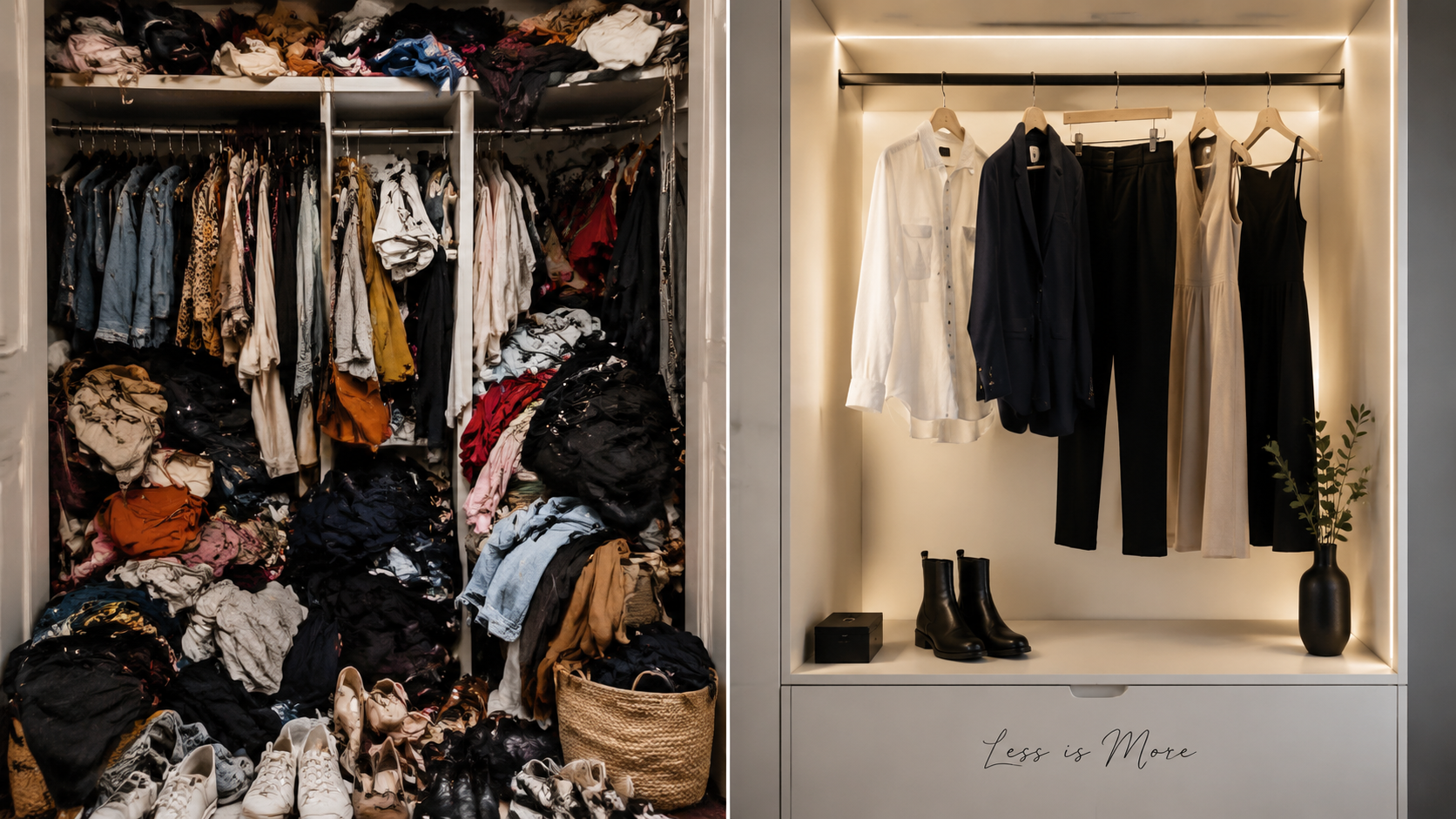
It was 7:42 AM on a Tuesday, and I was on the verge of tears, buried under a literal avalanche of fast-fashion polyester and denim. My bed looked like a retail clearance rack had exploded across the duvet. There were tags still attached to a neon blazer I bought on sale three months ago, three pairs of nearly identical black trousers that all fit weirdly around the waist, and a mountain of graphic tees I hadn’t touched since college. I had exactly twelve minutes before my morning commute, more than eighty items of clothing dangling in front of me, and the distinct, suffocating realization that I had absolutely nothing to wear.
1. The Paradox of Choice: Why More is Actually Less
We’ve been sold a beautiful, highly profitable lie: that more options equal more freedom. We are told that a massive, overflowing closet is the ultimate symbol of a curated life. But psychological science tells a completely different story.
Back in 2000, psychologists Sheena Iyengar and Mark Lepper conducted a famous study known as the “Jam Experiment.” They set up a display booth with twenty-four varieties of gourmet jam at an upscale grocery store. On another day, they set up a booth with only six varieties. While the larger display attracted more shoppers, the results were staggering: only 3% of the people who visited the large display actually bought jam. Meanwhile, 30% of the consumers exposed to the smaller selection made a purchase.
This is the Paradox of Choice in action, and it applies directly to your wardrobe. When you stare into a closet packed with eighty different pieces, your brain is forced to evaluate, compare, and predict how you’ll feel in every single permutation. Instead of feeling inspired, you experience decision fatigue. By the time you’ve picked out an outfit, your brain has expended a significant chunk of its daily cognitive fuel, leaving you feeling drained before you’ve even had your morning coffee.
2. The Emotional Ghost in Your Closet
When I finally decided to empty my entire wardrobe onto the floor to figure out why I was so miserable, I realized that my clothes weren’t just fabric—they were emotional anchors. We don’t just store garments; we store our anxieties, regrets, and aspirational personas.
As I sorted through the piles, I categorized the “ghosts” haunting my closet into four distinct types:
✨
The “Fantasy Self” Items
These are the clothes bought for a life you don’t actually live. For me, it was a pair of five-inch patent leather stilettos and an intricate boho maxi dress that required a specific type of strapless bra I didn’t own. I am a writer who works from a home office and walks three miles a day; my fantasy self was a jet-setting socialite. Keeping these items around served as a daily, subtle reprimand that I wasn’t being “glorious” enough.
💸
The “Guilt Trip” Garments
These are the expensive mistakes. The designer jeans bought on a whim that never quite fit right, or the luxury sweater that shrunk slightly in the wash. Every time I looked at them, I didn’t see fashion—I saw wasted money. I kept them out of guilt, hoping that by merely retaining custody of them, the financial loss would somehow magically reverse itself.
⏳
The “Someday When” Wardrobe
These are the clothes kept for a future body. “Someday when I lose ten pounds,” or “Someday when I start working out again.” Keeping clothes that do not fit your current reality is a form of passive-aggressive self-punishment. Every morning, they greet you with a reminder that your body is somehow incorrect.
🎒
The “Sentimental Safety Nets”
The college sweatshirt with holes in the armpits, the dress worn on a first date that ended badly but represented a specific era. While keeping a few sentimental items is completely fine, allowing them to take up premium real estate in your daily dressing area clogs your mental bandwidth.
3. The Birth of My First Capsule Wardrobe
Exhausted by the emotional baggage of my clutter, I decided to try an experiment. I had read about the concept of a capsule wardrobe—a term originally coined by London boutique owner Susie Faux in the 1970s and popularized by Donna Karan in 1985—but I always thought it was reserved for minimalist influencers who only wore beige linen and lived in stark, white apartments.
I wasn’t a minimalist. I liked color. I liked texture. But I desperately needed sanity.
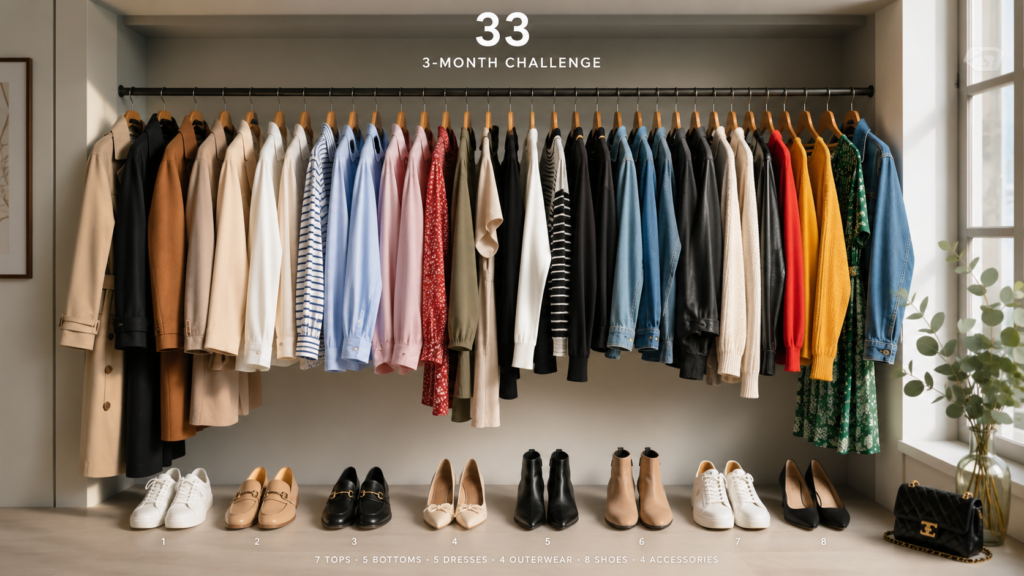
I set a rule: I would select 33 items to wear for the next three months. This count included tops, bottoms, dresses, outerwear, and shoes. It excluded sleepwear, workout gear (that was actually used for working out), underwear, and loungewear.
The remaining clothes weren’t thrown away immediately; instead, I packed them into plastic storage bins and hid them in the attic. This was my safety net. If I panicked or felt restricted, my old life was just a ladder climb away.
The first week felt strange. My closet looked shockingly empty—like a boutique hotel room or a high-end store that was running out of inventory. But by day four, something miraculous happened. I woke up, looked at the few options available, grabbed a pair of perfectly tailored trousers, a high-quality white cotton tee, and a structured blazer, and walked out the door in less than two minutes. I looked sharp, felt put together, and didn’t spend a single second second-guessing myself.
4. The Hidden Costs of Fast Fashion (And the Value of “Cost Per Wear”)
Fashion Economics
The Real Cost of Fast Fashion
By A Wardrobe Transformer
Switching to a capsule wardrobe completely reframed how I understood the economy of my clothing. When we buy a $20 shirt from a fast-fashion mega-retailer, we feel like we’ve won a prize. We think, “It’s only twenty bucks!”
But fast fashion is designed to degrade. It is engineered to stretch out of shape after three washes, to pill under the arms, and to lose its buttons. More importantly, it is designed to make you feel trendy for a micro-second before the next aesthetic cycle rolls out, forcing you back into the store to buy more.
The Shift: Cost Per Wear (CPW)
When you transition to a capsule wardrobe, your metric shifts from purchase price to Cost Per Wear (CPW). The formula is simple:
Total Cost of the GarmentNumber of Times Worn= Cost Per Wear
Let’s look at a real-world mathematical comparison from my own wardrobe transformation:
Item
Purchase Price
Number of Wears (1 Year)
Cost Per Wear
Fast-Fashion Polyester Blouse
$30.00
3 times (shrunk/pilled)
$10.00 / wear
High-Quality Silk/Cotton Shirt
$120.00
45 times (classic & durable)
$2.66 / wear
The premium shirt was four times more expensive upfront, but it was drastically cheaper over time because it held its shape, felt incredible against my skin, and didn’t go out of style within six weeks. A capsule wardrobe forces you to invest in quality over quantity, saving you thousands of dollars in the long run.
5. Step-by-Step: How to Build Your Own Capsule Wardrobe Without Panic
If you are currently staring at your own closet mountain and want to make the switch, do not try to do it all in twenty minutes. It is a process that requires a methodical, step-by-step approach. Here is the exact blueprint I used to transition smoothly:
Step 01
The Total Emptying
Take every single piece of clothing out of your closet. Yes, all of it. Place everything onto your bed or a clean floor space. The visual shock of seeing the sheer volume of what you own serves as an essential psychological catalyst for real change.
Step 02
The Four-Pile Sort
Go through each item individually with absolute honesty, and place it into one of these four distinct piles:
The “Hell Yes” Pile
Items that fit perfectly right now, make you feel highly confident, are in excellent condition, and seamlessly match your daily lifestyle.
The “Maybe / Seasonal” Pile
Pieces you genuinely love but aren’t right for the current season, or sentimental items you aren’t quite ready to part with just yet.
The Donate / Sell Pile
Clothes that are still in good condition but no longer fit your body, don’t match your evolving style, or generate unnecessary guilt.
The Trash Pile
Stained, torn, or completely worn-out garments that are far beyond repair. It’s time to let them go responsibly.
Step 03
Establish Your Base Palette
A successful capsule wardrobe relies heavily on cohesion. If every top matches every bottom, you can effortlessly create dozens of outfits from just a handful of pieces.
2 Neutral Base Colors
For foundational pieces (e.g., Black & Navy, or Camel & Grey)
2 Accent Colors
To bring joy and complement your skin tone (e.g., Emerald, Rust, or Blush)
Step 04
Select Your Anchor Pieces
Select your foundational items based entirely on your daily routine. If you work from home, your anchors might be high-quality knitwear; if you work in corporate, look for structured blazers. Here is a blueprint for a classic, balanced 30-piece seasonal capsule:
6
Tops
Tees, button-downs, silk camisoles
4
Sweaters
Varying weights for easy layering
5
Bottoms
Perfect jeans, trousers, casual skirts
3
Dresses
Versatile day-to-night pieces
4
Outerwear
Trench coat, leather or wool jacket
5
Shoes
White sneakers, loafers, classic boots
3
Accessories
Signature bag, versatile scarf, classic belt
Step 05
The Box Experiment
Take your “Maybe” pile along with your out-of-season items, pack them safely into boxes, and store them completely out of sight.
The 30-Day Rule: Leave them there for exactly one month. If you don’t think about a specific item or go digging through the box to retrieve it within those thirty days, you don’t actually need it. You can now confidently donate it without a single hint of regret.
6. The Unexpected Mental and Environmental Dividends
When I started this journey, I thought I was just solving an aesthetic problem. I thought I was simply trying to clean my room. I had no idea that minimizing my clothes would radically alter my mental health and lifestyle habits.
01 / SUSTAINABILITY
Environmental Re-alignment
The fashion industry is responsible for roughly 10% of global carbon emissions and consumes vast amounts of water. By shifting away from the constant consumer cycle of fast fashion, I stopped contributing to the cycle of textile waste that clogs landfills across the globe.
“Buying less means demanding less exploitation from manufacturing systems.”
02 / MINIMALISM
Radical Space Recovery
Suddenly, my bedroom felt like a sanctuary. There were no piles of discarded outfits on the floor, no overstuffed drawers that jammed every time I tried to open them. The physical lightness of the space translated directly into a profound feeling of mental spaciousness.
03 / IDENTITY
True Personal Style Discovery
When you wear only your absolute favorite things, you begin to develop a clear, signature look. You stop chasing fickle trends and start cultivating timeless style.
People began complementing my outfits far more after I reduced my wardrobe than they ever did when I owned hundreds of mediocre items.
Conclusion: True Abundance Lives in Less
It has been three years since that chaotic Tuesday morning avalanche, and I have never gone back to a cluttered closet. My seasonal capsules ebb and flow naturally with the weather, but the underlying philosophy remains entirely unchanged.
I no longer shop as a hobby or a cure for boredom. When I buy something new now, it is a deliberate, joyful investment in a piece of craftsmanship that I know I will cherish for years.
If you are feeling overwhelmed, trapped by your choices, or exhausted by the constant pressure to reinvent yourself through consumerism, I challenge you to take everything out of your closet this weekend. Try the box experiment. Embrace the beauty of a curated life.
You aren’t emptying your closet; you are making room for your life. And trust me—once you experience the profound peace of looking into a minimal wardrobe and seeing only things you love, you will never want to look back.
Frequently Asked Questions
Everything you need to know about building a capsule wardrobe.
A capsule wardrobe is a limited, curated collection of high-quality, versatile clothing items that can be easily interchanged to create a wide variety of outfits. Typically, a capsule consists of 30 to 40 items per season, including tops, bottoms, shoes, and outerwear.
Surprisingly, no! Because every item in a capsule wardrobe is selected for its high quality, comfort, and perfect fit, you spend your time wearing clothes that make you feel exceptional. The variety comes from creative layering and accessorizing, rather than cycling through low-quality items you only half-like.
Most people rotate their capsule wardrobes four times a year (or twice a year, depending on the climate). When a new season approaches, you store your current out-of-season clothes in boxes or another closet and pull out the appropriate pieces for the upcoming weather, evaluating what needs repair or replacement.
Absolutely not. In fact, you shouldn’t! The best way to start is the “Box Experiment.” Pack away the clothes you are unsure about and store them out of sight for a month or two. This allows you to test out the minimalist lifestyle without the anxiety of permanent disposal.
Yes. A capsule wardrobe does not have to be entirely black, white, and beige. The key is cohesion. If you love bright red or floral patterns, you can absolutely include them, provided they can be mixed and matched easily with your chosen base neutrals.